Digest #3 - The Illusion of Productivity

Many of us have built, or are in the process of building our lives with great deliberation: working hard, planning for the future, and carrying our responsibilities. In many ways, this effort pays off. And yet, we rarely pause to examine the quiet assumptions guiding our efforts.
The question of why may have crossed our minds, but we may have never truly sat with it. Each day is so busy, and when things seem broadly “on track,” it can feel unnecessary, or even unproductive, to interrupt the grind.
The Bhagavad-gita was originally spoken in Sanskrit, a language where one single word can hold an entire concept. One such word is tamas, often translated as the mode of ignorance.
Tamas is not about laziness or incompetence. It is about a lack of clarity regarding what truly matters beneath the surface. One of its symptoms is passivity: moving forward in life without deeply examining the direction or consequences of our actions.
A person may be highly competent, disciplined, and successful by the world’s standards, yet still be under the influence of tamas, acting with unclear expectations about fulfilment and purpose.
The Bhagavad-gita explains that when our awareness is dominated by tamas, we become bewildered. Consequently, the mind impulsively assigns meaning - gain or loss, success or failure - and our actions follow these conclusions accordingly.
This is why two people can face the same hardship and respond so differently: one grows through it, while the other collapses. The difference lies not in the circumstance itself, but in the refinement of the intelligence guiding the mind.
So the question becomes: how can we sharpen our intelligence, so that our actions are guided by clarity, and our lives by genuine purpose?
Engaging with revealed wisdom, such as the Bhagavad-gita, is one powerful step.
These teachings do not merely comfort us; they challenge our assumptions, train our discernment, and deepen our sense of responsibility.
In that sense, engaging with these weekly reflections is a way of learning how to live more consciously.
One Minute Practice
“Just one small positive thought in the morning can change your whole day.”
- Dalai Lama
As soon as you wake up, each day, this week:
Ground
Place both feet on the floor.
Take 3 deep breaths, in through the nose and out through the mouth.
Become aware of the body before the mind runs.
Orient
Complete this sentence out loud: “Today I choose to act with _____.” (Clarity. Honesty. Care. Presence. Courage. etc.)
Choose one word only, so you can easily go back to it throughout the day.
Translate into action
Ask yourself: “At which point in my day can I practice this?” (Speaking. Exercising. Cooking. Listening. etc.)
Then, continue your day…
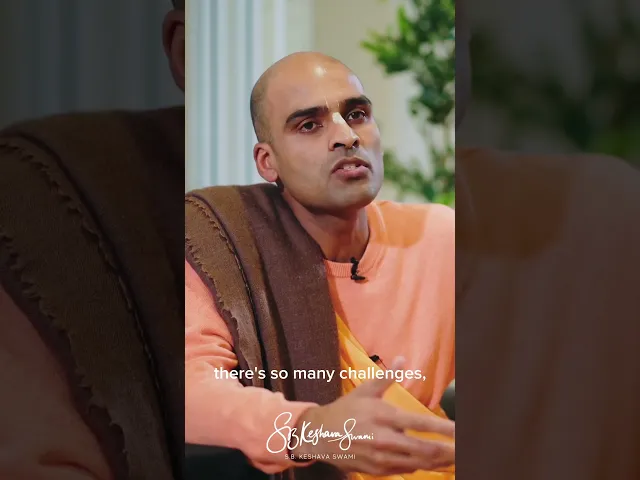
Watch this short video where S.B. Keshava Swami explains the relevance of the Bhagavad-gita in each of our lives. You might even be inspired to begin your own journey with it!